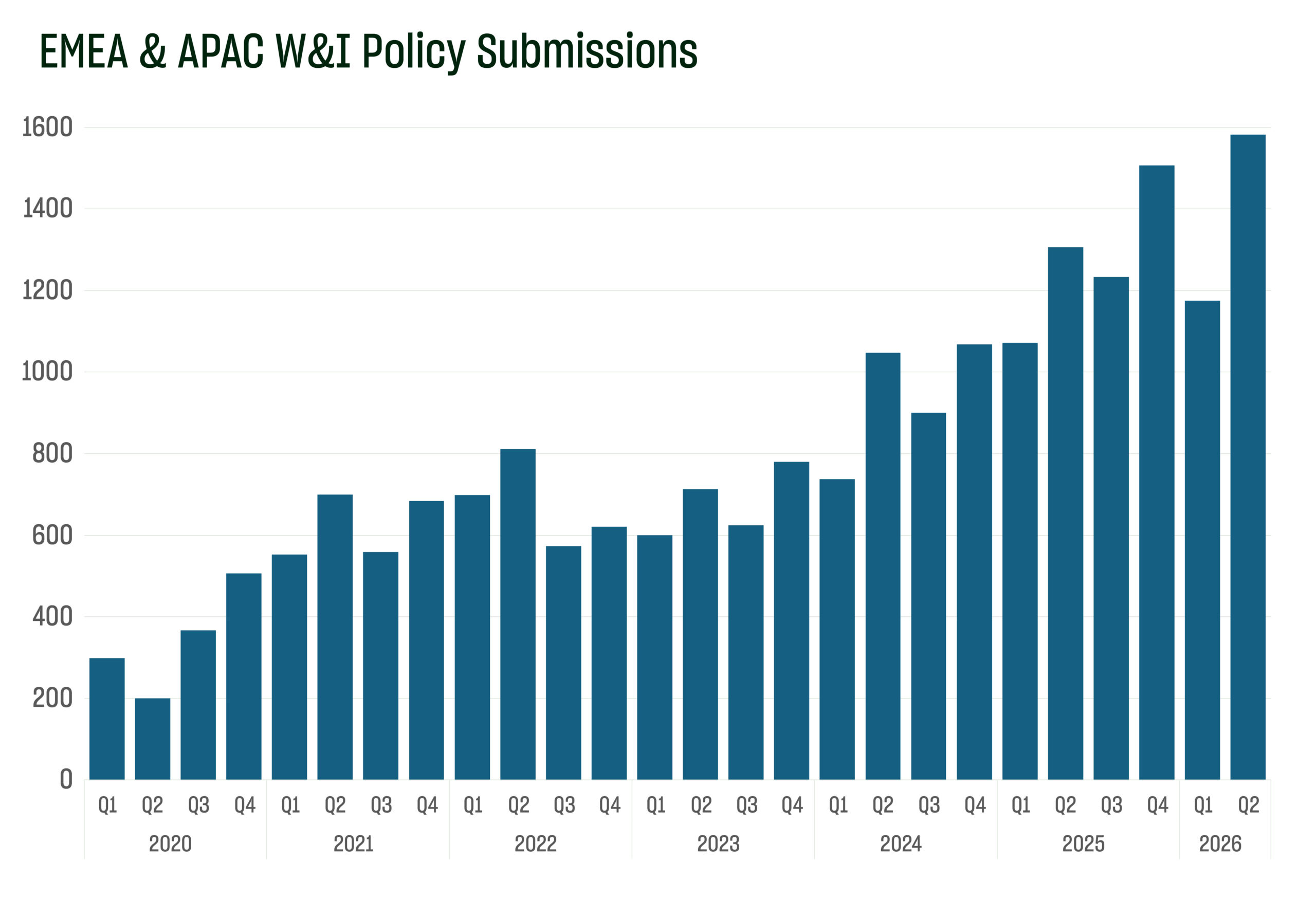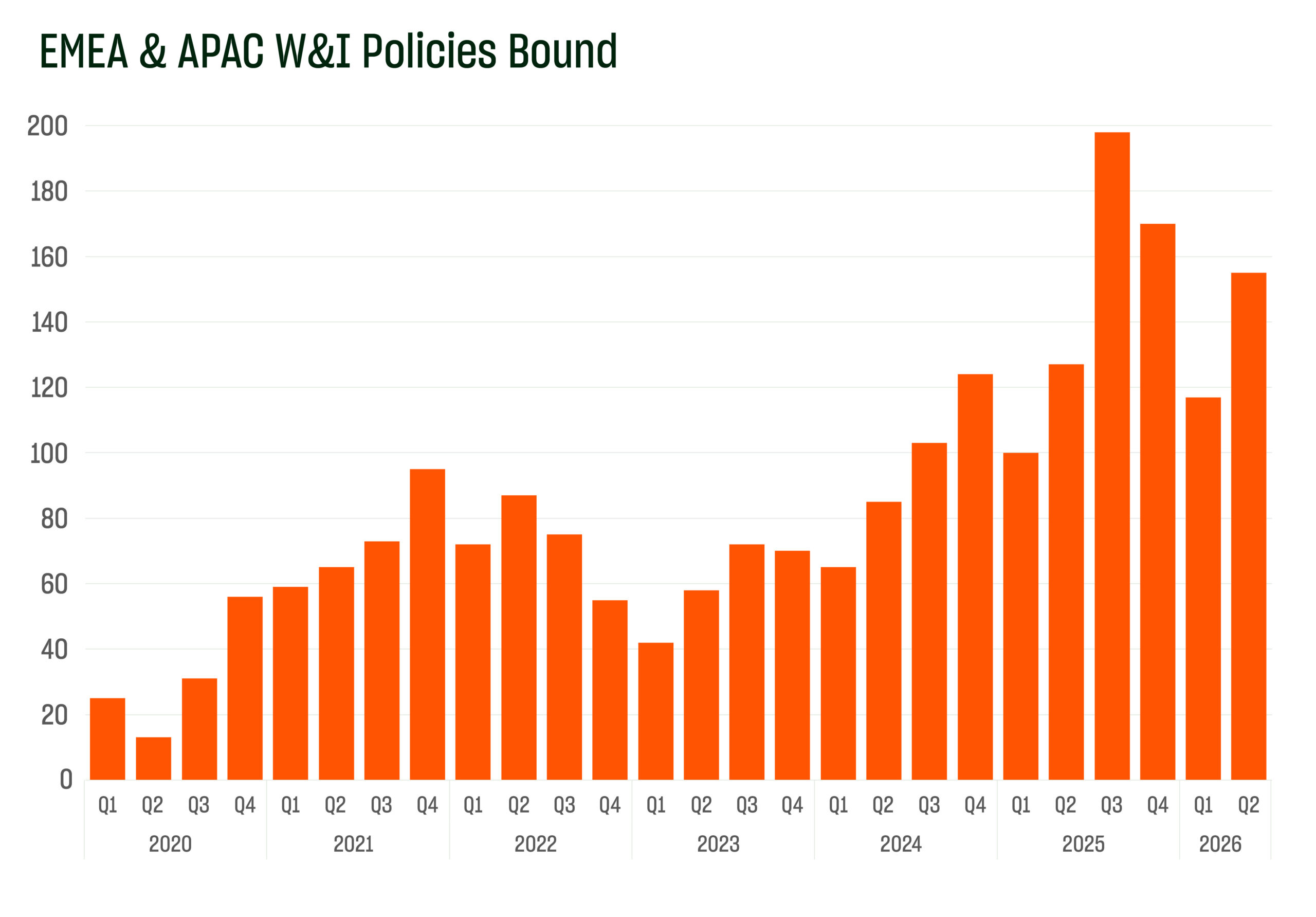


The current narrative on the W&I market suggests that it is a soft, over-supplied market pushing rates lower. Our Q2 across EMEA and APAC tells a different story: our busiest quarter on record, bigger deals, and signs that rate may be beginning to turn.
Here’s what stood out in our EMEA & APAC W&I book:
- 1,582 submissions in Q2 2026 – up 21% year-on-year and up 35% on Q1. The quarter started well and then accelerated. June alone brought 624 submissions, 29% more than June 2025.
- The median deal size has increased. Median enterprise value on submissions rose to ~$131m, up around 15% year-on-year, with the sub-$150m share of the pipeline falling from 58% to 53% as larger deals took over.
- APAC grew substantially – submissions up ~50% YoY, continuing the region’s expansion.
- Pricing is beginning to turn. After years of flat-to-lower rates, primary rate-on-line is showing early signs of firming – most clearly on deals of $150m and above.
The story the volume tells
Read the headlines and you’d expect a cautious deal market: higher-for-longer rates and geopolitical noise keeping volumes constrained. Some of that is real, but it is not consistent with what we’re seeing in terms of W&I submissions.
A 21% year-on-year rise in submissions – accelerating into June rather than fading into the summer – is the signature of a market that has stopped waiting. The median transaction is materially larger than a year ago, and the share of deals above $750m is expanding. Dealmakers aren’t just doing more deals – they’re doing bigger ones, and they’re insuring them.
That points to returning conviction at the larger end of the market, where diligence is heavier, financing is harder, and buyers commit only when they believe a deal will close.
Rate is beginning to climb – and still has room to run
The prevailing narrative in transactional risk for the last few years has been oversupply – new capacity, new entrants, and a relentless grind lower in rate-on-line. Our Q2 data challenges that story.
Aggregate primary rate-on-line in our EMEA & APAC book has started to show signs of increasing, particularly on deals of $150m and above.
We welcome the direction of travel, but we don’t think the job is done. Rate needs to continue rising, particularly on the complex, larger transactions where the severity risk is greatest, if the market is to sustainably fund the claims and service standards our brokers and clients expect.
Our most recent Global RWI Claims Study covered the twelve months to 30 June 2025, during which we paid $314m in claims globally. Within EMEA and APAC alone, we’ve now incurred close to $200m of losses since 2018. Volume growth is welcome, but it is only sustainable if it is underwritten and priced to perform when claims arrive. Q2’s pricing direction is a step the right way – but only a step.
Sponsors and strategics are advancing together
Q2’s growth was broad-based rather than a private-equity-led rebound: sponsor-backed and strategic binds each rose around 25% year-on-year. The difference between them is size, not appetite – among the deals we bound, the median private-equity transaction was roughly 40% larger than the median strategic one, and far more likely to sit in the >$750m mega-deal bracket.
Where the growth is coming from
The sector rotation in our Q2 submission mix reads like a map of the macro. The fastest-growing areas year-on-year were Military & Defense (off a small base, but up more than sixfold), Construction (+133%), high-tech Manufacturing (+102%), Hospitality (+100%), Real Estate (+50%) and Energy (+46%). Meanwhile, more rate-sensitive and consumer-adjacent corners – low-tech manufacturing, biotech/pharma and agriculture – reduced in volume.
What next
Submissions are at record levels and skewing larger, buyers are active across both financial sponsors and strategics, APAC is compounding – and primary rate is beginning to climb where the risk is most complex. Busier and better-priced is an unusual combination. But “better” is not yet “adequate”: the direction of pricing is encouraging, and it needs to continue. We think the underlying deal market is healthy, and that a market this active can, and should, support pricing that reflects the real risks being underwritten.
For H2, we will be watching to see whether the larger-deal skew holds, whether pricing discipline sticks as volumes climb, and whether APAC keeps compounding. On the evidence of Q2, we’d lean toward yes on all three.
Do these trends match what you’re seeing? We’d welcome the conversation.